Taya Foundation

Bulletin Board

Mandatory Platform Protocol — Public Access NoticeTF-PAP-2026-001

Transitioning from Public Search to Secured Audit Infrastructure

Based on verified empirical metrics, approximately 400 financial institutions and 850 healthcare institutions and commercial enterprises have historically free-ridden on the Taya Foundation's strategic insights, engineering blueprints, and policy analyses via public discovery vectors (LinkedIn Search), capturing up to 1,500 searches on Financial Institutions and 350 searches on Healthcare institutions per week without formal accreditation.

To enforce institutional transparency and protect the integrity of the sovereign auditing process, the Taya Foundation hereby enacts the following access amendments for Wing A Healthcare Institutions and Wing B Financial Institutions. Financial institutions seeking data visibility for risk mitigation, corporate compliance, or defense submissions under The 4 Rules Protocol must clear procedural fees under the approved corporate matrix:

$35,000

Enterprise Silver

/ year

$45,000

Enterprise Gold

/ year

$100,000

Diamond Sovereign

/ year

Failure to comply constitutes a formal waiver of all data access rights and an acknowledgment of unsanctioned intelligence extraction.

→ Register for Enterprise Access

Welcome to the Taya Foundation Bulletin Board

This board provides official system updates, compliance clarifications, and institutional guidance. Select any post from the list to view full details.

✦ What's New — Divine Marketplace Innovation Post ✦
LMT-EXPRESS · The Taya Foundation · June 15, 2026

World Disruptive Tangible Standard: The Final Replacement of the Legacy Ambulance Era

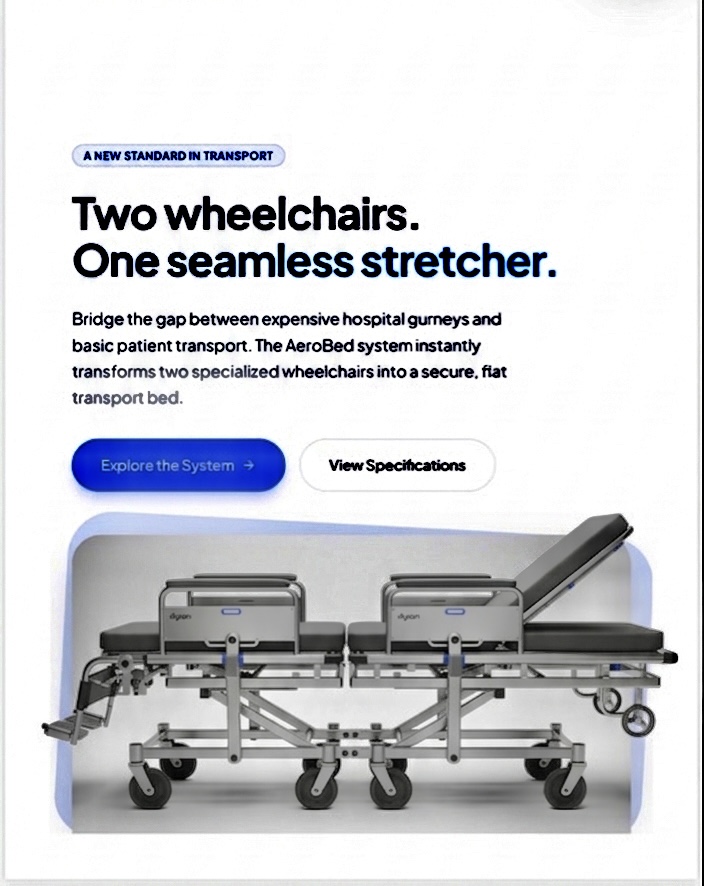
AeroBed Innovation Poster 1
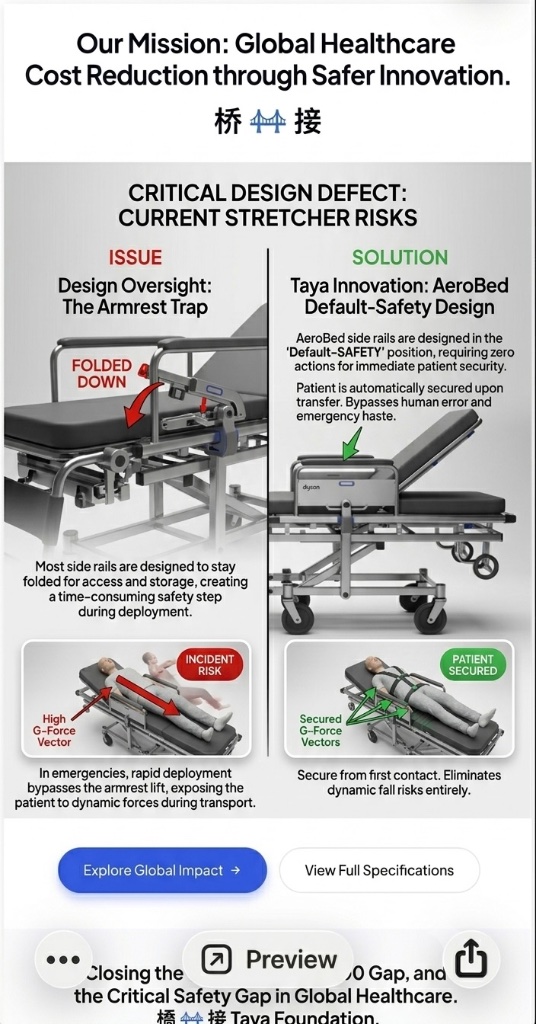
AeroBed Innovation Poster 2
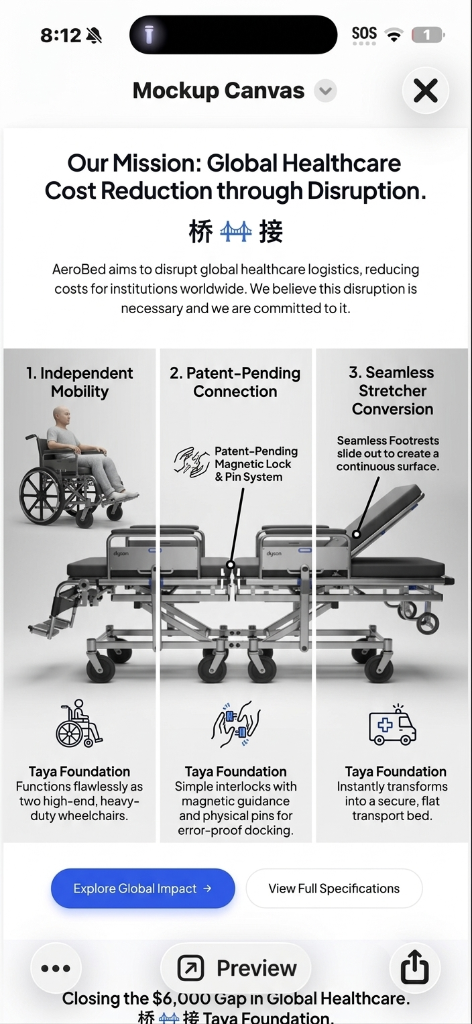
AeroBed Innovation Poster 3
20%

Final Frontier

The last piece LMT-EXPRESS needed

Patient Mobility Innovation

Dual Wheelchair Medical Transport System

"Reforming the Final 20% of EMT Trips — The End of Ambulance Reliance"

The 80/20 Reform — Now Complete

LMT-EXPRESS has already replaced 80% of ambulance trips — behavioral health, high-risk discharges, and standard NEMT. Today, we address the critical final 20%: patients who require a lying-flat transport position. This is the last piece that kept expensive ambulances in the equation.

80% Already Solved ✓

+

Final 20% — NOW ✦

=

100%

Complete

$500

vs. $6,000 Gurney

50%

Space Saved in Storage

2min

Rapid Conversion

The Current Problem

Cost & Bulk

Hospital gurneys cost $1,500–$8,000. They demand significant storage and strain facility budgets.

Transfer Risk

Moving patients between chairs and stretchers is the #1 cause of caregiver injury and patient distress.

Rural Gaps

70% of rural clinics lack proper gurneys, leaving caregivers without safe lying transport options.

The Connection Concept

Two standard wheelchairs operate independently for seated transport. When needed, they lock side-by-side to form a full-length lying bed — instantly converting any LMT-EXPRESS vehicle into a stretcher-capable transport unit.

No structural modifications required
Adapter kit weighs under 2kg
180° recline for lying flat

4 Simple Steps to Conversion

1

Position

Align two wheelchairs side-by-side, armrests touching.

2

Lock

Engage magnetic side-rail locking brackets.

3

Recline

Fold both backrests flat via sync mechanism.

4

Transport

Secure patient with safety straps. Push from both ends.

LMT-EXPRESS — 100% Complete

The Ambulance Era Is Over.

From behavioral health discharges to lying-flat patient transport — LMT-EXPRESS now covers every single transport scenario. The final piece has arrived.

#PatientMobilityInnovation#LMTExpress#FinalPiece#AmbulanceReplacement#DualWheelchairSystem#EMTALA#TayaFoundation

Phase III — Statutory Enforcement — Now Active

Page 1 of 19 · 187 total bulletins
Official Federal Reference Document

Federal EMTALA Compliance Textbook

National Standard for Hospital Emergency Operations

For Use by All U.S. Hospitals and All State Hospital Associations — Published by The Taya Foundation

Primary Use

State Hospital Association Curriculum Realignment

Authority

42 U.S.C. § 1395dd — Federal EMTALA Statute

Coverage

All 25,000+ U.S. EMTALA-Governed Institutions

Section I

Federal Purpose & Authority

1. EMTALA's Federal Mandate

42 U.S.C. § 1395dd — Non‑Waivable Federal Obligation

EMTALA establishes a national, non‑waivable obligation for all Medicare‑participating hospitals to:

Provide a Medical Screening Examination (MSE)
Determine whether an Emergency Medical Condition (EMC) exists
Provide stabilizing treatment
Arrange appropriate transfer when necessary

This obligation applies to every individual, regardless of:

Insurance status
Ability to pay
Housing status
Behavioral presentation
Frequency of visits
Intent

2. Federal Enforcement Architecture

Hospitals must understand the federal enforcement chain:

CMS—Survey & Certification
OIG—Civil Monetary Penalties (CMPs)
DOJ—Federal Litigation
QIOs—Medical Review of Transfers
MACs—Local Coverage Determinations (LCDs)
HHS—Regulatory Oversight

This textbook defines the federal standard that all states must align with.

Section II

National Risk Categories

CMS‑recognized EMTALA violation categories — mandatory training for every hospital

1Failure to provide an MSE
2Failure to stabilize
3Inappropriate transfer
4Delay due to insurance inquiry
5Security‑based redirection
6Pattern‑based refusal
7Failure to accept appropriate transfer
8Failure to maintain on‑call coverage
9Failure to document appropriately
10Failure to provide specialized capabilities

These categories form the national risk map.

Section III

National ED Staff Competency Standards

Every hospital must train staff to the following federal competencies

1

Intake Competency

  • Immediate registration
  • No delay for insurance
  • No redirection by security
2

Triage Competency

  • Objective assessment
  • No pattern‑based assumptions
  • No "frequent flyer" logic
3

MSE Competency

  • Performed by qualified medical personnel
  • Comprehensive and documented
  • Intent‑neutral
4

Stabilization Competency

  • Treat the EMC
  • Prevent deterioration
  • Document interventions
5

Transfer Competency

  • Only when medically appropriate
  • Physician certification required
  • Receiving hospital acceptance required
6

Disposition Competency

  • Safe discharge
  • Clear documentation
  • No subjective reasoning

Section IV

National Model Policies

Federal templates that State Hospital Associations will adapt

1

Model EMTALA Intake Policy

Defines universal intake requirements.

2

Model MSE Policy

Defines who may perform MSEs and how.

3

Model Stabilization Policy

Defines stabilization obligations.

4

Model Transfer Policy

Defines appropriate transfer requirements.

5

Model Winter Homeless Presentation Policy

Your new blind‑spot module — now a national standard.

View Training Module 7 →
New

These policies are the federal originals that states must build on.

Section V

National Clinical Scenarios

Universal scenarios that apply in every state — must be included in all training

1Winter Homeless Presentation (Blind Spot)National Standard
2Behavioral Health Emergency
3Substance Use Presentation
4Obstetric Emergency
5Pediatric Emergency
6Refusal by Receiving Hospital
7Patient Elopement During MSE
8Law Enforcement‑Involved Presentation
9Non‑English‑Speaking Patient
10Unaccompanied Minor

These scenarios are universal and federal.

Section VI

National Documentation Standards

Hospitals MUST document:

Vital signs
Objective findings
Clinical reasoning
Stabilization steps
Transfer details
Receiving hospital acceptance

Hospitals must NEVER document:

"Frequent flyer"
"Non‑emergent history"
"Seeking shelter"
"Manipulative behavior"
"No medical need based on prior visits"

These phrases appear in CMS violation reports.

Section VII

Federal Workflows

National workflows that every hospital application must include

1

MSE Workflow

From arrival → registration → MSE → documentation.

2

Stabilization Workflow

From EMC identification → treatment → reassessment.

3

Transfer Workflow

From EMC determination → physician certification → receiving acceptance → transport.

4

Winter Homeless Blind Spot Workflow

Your new national standard.

5

Behavioral Health Workflow

For psychiatric and substance‑related emergencies.

These workflows are the federal backbone.

Section VIII

National Competency Exam Standards

Requirements for all certification examinations under this standard

Question Volume

10–20 questions per module

Scenario‑Based

Required in all modules

Documentation‑Based

Required in all modules

Cumulative Final Exam

Required for full certification

Scoring Rubric

National standard — 80% minimum passing score

Module 7 Exam

Winter Homeless Blind Spot — Available now

Take Exam →

This becomes the national certification standard.

Section IX

Federal Summary for State Alignment

This Textbook Provides:

  • The federal floor
  • The national standard
  • The CMS‑aligned architecture
  • The universal workflows
  • The model policies
  • The national scenarios
  • The competency standards

State Hospital Associations Will Use This To:

  • Update their outdated curricula
  • Align their training with federal law
  • Integrate your modules
  • Adopt your certification
  • Correct their blind spots

Federal Declaration

This is the national reference document they have been missing.

— The Taya Foundation · National Reformer Office

base44
Edit with Base44